
FICA Taxes Explained: What 7.65% of Your Pay Actually Buys
September 28, 2026
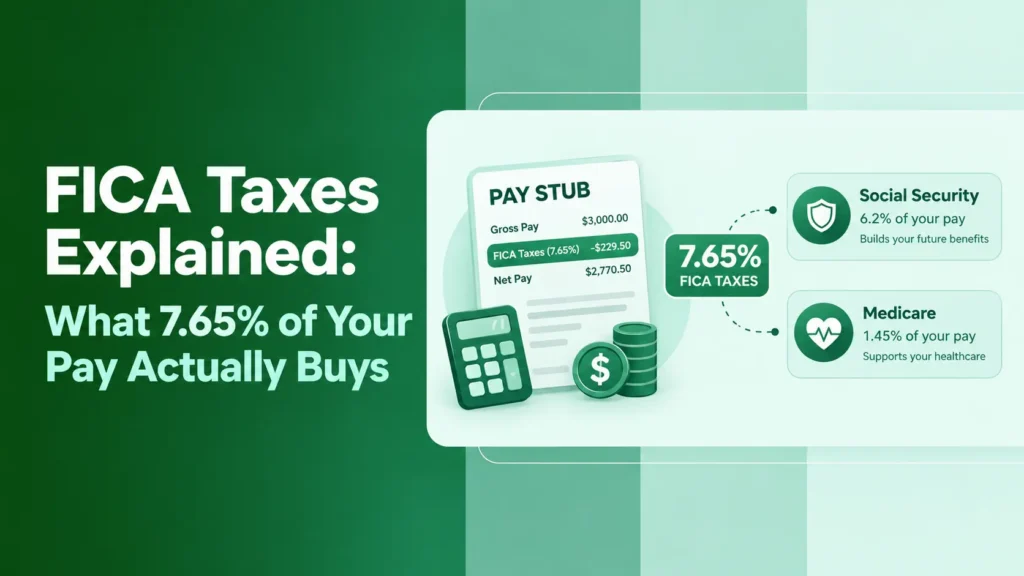
FICA taxes take 7.65% of your pay. That is 6.2% for Social Security and 1.45% for Medicare, and your employer pays the same amount again.
In return you build four things: retirement income, disability cover, survivor benefits for your family, and premium-free Medicare Part A from age 65.
This guide covers the 2026 rates, the wage base, who pays what, and the part most articles skip: what the money actually buys. Check your own figures with our free paycheck calculator.
What FICA stands for and what it costs
FICA is the Federal Insurance Contributions Act. It is the law that requires Social Security and Medicare tax to come out of your wages.
Here are the 2026 employee rates.
| Tax | Rate | 2026 limit | Maximum you pay |
| Social Security (OASDI) | 6.2% | First $184,500 of wages | $11,439 |
| Medicare | 1.45% | No limit | No maximum |
| Additional Medicare | 0.9% | Wages above $200,000 single | No maximum |
| Total standard rate | 7.65% |
The $184,500 taxable maximum for 2026 comes from the Social Security Administration. It rises most years with average wages.
The three things FICA actually buys
Social Security is not only a pension. The formal name, OASDI, spells out all three parts.
1. Old age: retirement income
The part everyone knows. You claim it from age 62 at the earliest, with a larger monthly payment the longer you wait.
The average monthly retirement benefit is $2,071 in 2026, up from $2,015 after the 2.8% cost-of-living increase.
Your own figure depends on your 35 highest-earning years and the age you claim. It is not a flat amount.
2. Disability: insurance you hope not to use
If you cannot work because of a long-term medical condition, Social Security Disability Insurance pays a monthly benefit.
Private disability cover for the same protection would cost real money. That cost is part of what your 6.2% buys.
3. Survivors: cover for your family
If you die, your spouse and dependent children may receive monthly survivor benefits based on your earnings record.
This is life insurance built into the payroll tax, and most people do not realise they have it.
And Medicare Part A at 65
Your 1.45% Medicare contribution buys premium-free Part A hospital cover once you reach 65, if you have enough work credits.
Part B, which covers doctor visits, has a monthly premium. Part A does not, and that is what FICA pays for.
How much work qualifies you
You do not get these benefits automatically. You earn them through work credits.
- You need 40 credits for retirement benefits, which is about ten years of work
- In 2026 you earn one credit for every $1,890 of covered earnings
- You can earn a maximum of four credits a year
- So $7,560 in 2026 earns you a full year of credits
The threshold is low by design. Part-time and seasonal work still counts, and you can earn all four credits in a single month if you earn enough. Figures are from the SSA’s guide to earning credits.
Disability and survivor benefits need fewer credits, and the number depends on your age when you become disabled or die.
The 2026 Social Security wage base
Social Security only applies to the first $184,500 you earn in 2026. Above that, nothing more is withheld.
That gives a maximum employee contribution of $11,439 for the year.
What happens when you cross it
Your paycheck gets bigger. The Social Security line disappears from your stub and your take-home pay rises for the rest of the year.
Medicare keeps coming out, because it has no cap at all.
On 1 January the counter resets and Social Security starts again from your first dollar.
If you change jobs mid-year, each employer counts from zero. You may overpay Social Security across two jobs, and you claim the excess back on your tax return. Our guide to reading your pay stub shows where to check the year-to-date figure.
Additional Medicare Tax
High earners pay an extra 0.9% Medicare tax. It applies only above a threshold set by filing status.
| Filing status | Threshold |
| Single or head of household | $200,000 |
| Married filing jointly | $250,000 |
| Married filing separately | $125,000 |
Your employer starts withholding it once your wages with them pass $200,000, whatever your filing status.
Employers do not match this one. Unlike the rest of FICA, the extra 0.9% is yours alone.
Your employer pays the same again
The 7.65% on your stub is only half of what goes to Social Security and Medicare on your wages.
Your employer pays a matching 7.65%. The total is 15.3% of your pay, and only half of it is visible to you.
| Who pays | Social Security | Medicare | Total |
| You | 6.2% | 1.45% | 7.65% |
| Your employer | 6.2% | 1.45% | 7.65% |
| Combined | 12.4% | 2.9% | 15.3% |
Why self-employed people pay 15.3%
A self-employed person is both employee and employer, so they pay both halves.
That is 12.4% for Social Security plus 2.9% for Medicare, known as self-employment tax.
Half of it is deductible on their federal return, which softens the effect but does not remove it.
Does the new no tax on tips rule remove FICA?
No, and this is the most common misunderstanding about the 2026 changes.
The tips and overtime deductions created by the One Big Beautiful Bill Act apply to federal income tax only.
Tips and overtime are still wages for Social Security and Medicare purposes. Your employer still withholds 7.65% from them.
| Income type | Federal income tax | FICA |
| Qualified tips | Deduction up to $25,000 | Still withheld at 7.65% |
| Qualified overtime | Deduction up to $12,500 | Still withheld at 7.65% |
| Regular wages | Normal withholding | Still withheld at 7.65% |
The deduction is claimed on your tax return. It does not appear as a smaller FICA line on your paycheck.
Both deductions apply to tax years 2025 through 2028 and phase out above $150,000 of income, or $300,000 for joint filers.
If you earn tips or regular overtime, read our 2026 W-4 guide for how to claim these on the Deductions Worksheet, and use the overtime calculator to see the effect on a real paycheck.
Which deductions reduce FICA and which do not
Pre-tax benefits do not all behave the same way. This trips up most online calculators.
| Deduction | Reduces income tax wages? | Reduces FICA wages? |
| Traditional 401(k) | Yes | No |
| Roth 401(k) | No | No |
| Medical, dental, vision premiums | Yes | Yes |
| HSA contribution | Yes | Yes |
| FSA contribution | Yes | Yes |
Health premiums, HSA and FSA contributions run through a Section 125 cafeteria plan, which is exempt from FICA.
A 401(k) contribution is not. You defer income tax on it now, but you pay Social Security and Medicare on it anyway.
In practice a $3,000 HSA contribution saves you more this year than a $3,000 traditional 401(k) contribution. Compare both on the 401(k) paycheck calculator.
Who does not pay FICA
Almost every US employee pays it. The exceptions are narrow.
- Students working for the school they are enrolled at, in some circumstances
- Certain non-resident aliens on specific visa categories
- Members of some religious groups that hold a recognised exemption
- Some state and local government employees covered by a separate public pension
If you think you qualify, confirm it with your employer and the SSA. Getting this wrong costs you benefit credits, not just tax.
Is FICA worth it?
That depends on your earnings history, how long you live, and whether you ever need the disability or survivor cover.
What can be stated plainly is the arithmetic. Someone paying the 2026 maximum contributes $11,439 in a year, and their employer adds the same.
The average retirement benefit is $2,071 a month in 2026, and it is adjusted for inflation every year for life.
Social Security is also not subject to market risk and does not run out if you live a long time. Those features are hard to buy privately at any price.
None of that is a recommendation about your own retirement planning. It is context for a deduction you have no choice about.
Frequently asked questions
What is FICA and what does it pay for?
FICA stands for the Federal Insurance Contributions Act. It takes 7.65% of your pay, split as 6.2% for Social Security and 1.45% for Medicare. It funds retirement income, disability cover, survivor benefits for your family, and premium-free Medicare Part A hospital cover from age 65.
How much is FICA tax in 2026?
Employees pay 7.65% of wages. Social Security takes 6.2% on the first $184,500 earned in 2026, so the maximum is $11,439. Medicare takes 1.45% on all wages with no cap. Your employer pays the same 7.65% again on top of your wages.
How many work credits do I need for Social Security?
You need 40 credits, which is about ten years of work. In 2026 you earn one credit for every $1,890 of covered earnings, up to four credits a year. That means $7,560 in 2026 earns you a full year of credits, however long you worked for it.
What happens when I hit the Social Security wage base?
Social Security tax stops for the rest of the year once your wages pass $184,500 in 2026. Your take-home pay rises from that paycheck onward. Medicare keeps coming out, because it has no cap, and the counter resets on 1 January.
Does the no tax on tips rule remove FICA from my tips?
No. The tips and overtime deductions apply to federal income tax only. Tips and overtime remain wages for Social Security and Medicare purposes, so your employer still withholds 7.65% from them. The deduction is claimed on your return, not through lower FICA withholding.
Does a 401(k) contribution reduce FICA tax?
No. A traditional 401(k) contribution lowers the income your federal and state income tax is calculated on, but it is still subject to Social Security and Medicare. Health premiums, HSA and FSA contributions do reduce FICA wages, because they run through a Section 125 cafeteria plan.
Why do self-employed people pay 15.3%?
Because they pay both halves. An employee pays 7.65% and the employer pays another 7.65%. A self-employed person is both, so they pay 12.4% for Social Security plus 2.9% for Medicare. Half of it is deductible on their federal return.
What is the Additional Medicare Tax?
It is an extra 0.9% on wages above $200,000 for single filers, $250,000 for married filing jointly, and $125,000 for married filing separately. Employers start withholding it once your wages with them pass $200,000, whatever your filing status. Employers do not match it.
The short version
- FICA is 7.65% of your pay: 6.2% Social Security and 1.45% Medicare
- Your employer pays the same again, so 15.3% of your wages goes in total
- Social Security stops at $184,500 in 2026, capping your contribution at $11,439
- It buys retirement income, disability cover, survivor benefits and Medicare Part A
- You need 40 credits, and $1,890 of earnings buys one credit in 2026
- Tips and overtime still pay FICA, whatever the income tax deduction says
See exactly what FICA takes from your own pay on the paycheck calculator, or read how your paycheck is calculated for the full withholding method.
These figures are estimates for informational purposes and are not tax advice. Actual withholding depends on your employer’s payroll system, your year-to-date wages and your specific W-4. Federal rates come from IRS Rev. Proc. 2025-32 and the SSA 2026 announcement; state rates come from each state’s own withholding guide, with the source and verification date published on every state page. Read the methodology, or see who maintains this data.