
How Your Paycheck Is Calculated in 2026: The Complete Guide
Check your gross pay, pre-tax deductions, FICA, federal and state tax. See the real numbers, step by step.
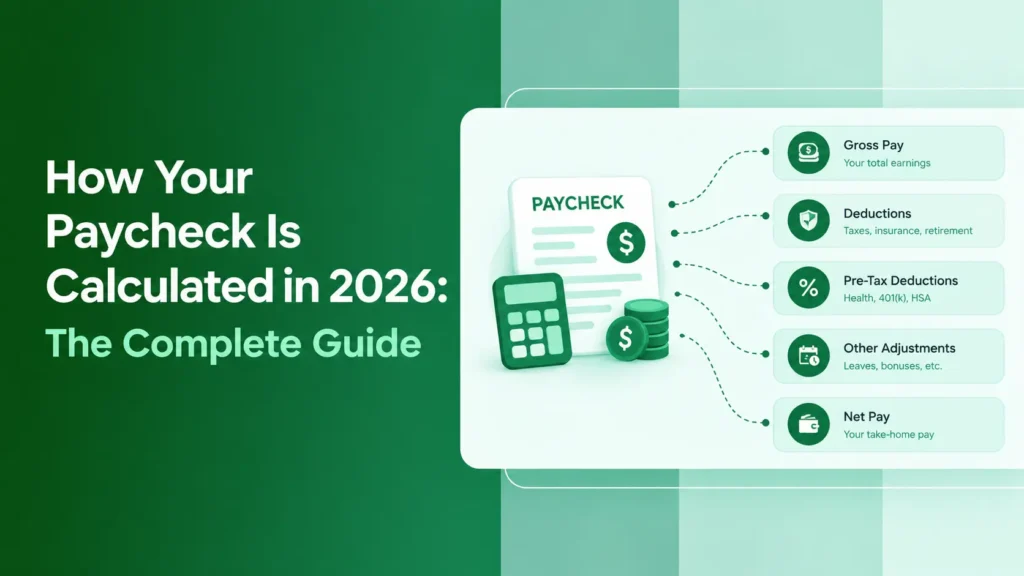
Your paycheck is calculated in six steps, and payroll always follows them in the same order. It starts with your gross pay. Then it subtracts pre-tax deductions, withholds Social Security and Medicare, calculates federal income tax, applies state and local tax, and removes post-tax deductions. What is left is your net pay.
This guide walks through each step using the actual 2026 figures. You will see where every dollar goes.
All numbers here come from IRS Revenue Procedure 2025-32 and the Social Security Administration. You can check your own figures with our free paycheck calculator.
The six steps payroll follows
Every US employer runs the same sequence. The order matters, because each step changes the amount the next step works with.
- Calculate gross pay for the pay period
- Subtract pre-tax deductions
- Withhold FICA: Social Security and Medicare
- Calculate federal income tax withholding
- Apply state and local income tax
- Subtract post-tax deductions to reach net pay
Swap any two of these and the final number is wrong. That is why a 401(k) contribution lowers your income tax but not your Social Security tax.
Step 1: Work out your gross pay
Gross pay is what you earn before anything comes out. It is the number in your offer letter, divided into pay periods.
If you are on a salary
Divide your annual salary by your number of pay periods. Here is what $75,000 looks like at each common frequency.
| Pay frequency | Periods per year | Gross per paycheck |
| Weekly | 52 | $1,442.31 |
| Every two weeks (biweekly) | 26 | $2,884.62 |
| Twice a month (semi-monthly) | 24 | $3,125.00 |
| Monthly | 12 | $6,250.00 |
Biweekly and semi-monthly are not the same thing. Biweekly pays every 14 days, which gives 26 paychecks. Semi-monthly pays on two fixed dates, which gives 24. Our biweekly paycheck calculator covers the difference, including years with 27 paychecks.
If you are paid hourly
Multiply your hourly rate by the hours you worked in the period. Overtime is added on top.
- Regular hours: rate multiplied by hours worked
- Overtime: rate multiplied by 1.5, for hours over 40 in a week
- Double time: rate multiplied by 2, where state law or your contract requires it
At $25 an hour and 40 hours a week, gross pay is $1,000 a week. Eight hours of overtime adds $300, taking the week to $1,300. Work it out for your own hours with the hourly paycheck calculator or the overtime calculator.
Step 2: Pre-tax deductions come out first
Pre-tax deductions are taken from gross pay before taxes are calculated. That lowers the income your tax is based on.
Common pre-tax deductions include:
- Traditional 401(k) or 403(b) contributions
- Health, dental and vision insurance premiums
- Health Savings Account (HSA) contributions
- Flexible Spending Account (FSA) contributions
- Commuter and parking benefits
The difference most paycheck calculators get wrong
Not all pre-tax deductions behave the same way. This is the detail that separates an accurate calculation from a rough guess.
A traditional 401(k) contribution lowers your federal and state income tax. It does not lower your Social Security or Medicare tax. You still pay FICA on that money.
Health premiums, HSA and FSA contributions run through a Section 125 cafeteria plan. They lower both your income tax and your FICA.
| Deduction | Cuts income tax? | Cuts FICA? |
| Traditional 401(k) | Yes | No |
| Health insurance premium | Yes | Yes |
| HSA contribution | Yes | Yes |
| FSA contribution | Yes | Yes |
| Roth 401(k) | No | No |
In practice this means a $3,000 HSA contribution saves you more this year than a $3,000 traditional 401(k) contribution. See the effect on your own pay with the 401(k) paycheck calculator.
Step 3: FICA taxes, Social Security and Medicare
FICA is the flat payroll tax that funds Social Security and Medicare. Almost every US employee pays it.
Here are the 2026 employee rates.
| Tax | Employee rate | 2026 limit |
| Social Security (OASDI) | 6.2% | Wages up to $184,500 |
| Medicare | 1.45% | No wage limit |
| Additional Medicare | 0.9% | Wages above $200,000 (single) |
The 2026 Social Security wage base
Social Security is charged on the first $184,500 you earn in 2026. Above that, nothing more is withheld.
The maximum any employee pays into Social Security in 2026 is $11,439. High earners see their paycheck go up part-way through the year when they cross the cap.
Additional Medicare tax
An extra 0.9% applies to wages above a threshold that depends on your filing status.
- Single or head of household: $200,000
- Married filing jointly: $250,000
- Married filing separately: $125,000
Your employer starts withholding it once your wages with them pass $200,000, whatever your filing status.
Step 4: Federal income tax withholding
This is the largest deduction for most people, and the one that varies most.
Payroll uses the IRS percentage method, set out in Publication 15-T. It works like this.
- Take your taxable wages for this period and multiply by the number of pay periods, to get an annual figure
- Add other income and subtract deductions from your Form W-4
- Subtract your standard deduction
- Apply the tax brackets to what is left
- Subtract your dependent credits
- Divide back down by the number of pay periods
Your employer is assuming you earn this much all year. That is why a single large paycheck gets over-withheld.
2026 standard deduction
| Filing status | 2026 standard deduction |
| Single | $16,100 |
| Married filing jointly | $32,200 |
| Married filing separately | $16,100 |
| Head of household | $24,150 |
2026 federal tax brackets
The US uses a progressive system. You do not pay one rate on everything you earn.
| Rate | Single | Married filing jointly |
| 10% | $0 to $12,400 | $0 to $24,800 |
| 12% | $12,400 to $50,400 | $24,800 to $100,800 |
| 22% | $50,400 to $105,700 | $100,800 to $211,400 |
| 24% | $105,700 to $201,775 | $211,400 to $403,550 |
| 32% | $201,775 to $256,225 | $403,550 to $512,450 |
| 35% | $256,225 to $640,600 | $512,450 to $768,700 |
| 37% | Over $640,600 | Over $768,700 |
How your W-4 changes the number
Your Form W-4 tells payroll how much to withhold. Four entries do the work.
- Filing status: sets which bracket table and standard deduction apply
- Step 2, two jobs: halves the standard deduction and the bracket thresholds
- Step 3, dependents: $2,000 for each child under 17, $500 for each other dependent
- Step 4c, extra withholding: a flat dollar amount added to every paycheck
Dependent credits reduce withholding directly. Two children under 17 lower your annual federal withholding by $4,000.
Step 5: State and local income tax
State tax varies more than any other part of your paycheck. It ranges from nothing to over 10%.
The nine states with no income tax
Alaska, Florida, Nevada, New Hampshire, South Dakota, Tennessee, Texas, Washington and Wyoming do not tax wage income.
You still pay federal income tax and FICA in all nine. Washington also withholds paid family leave and long-term care premiums. Our guide to states with no income tax covers what each one still takes.
Flat rate states and bracket states
Some states charge one rate on all income. Others use brackets like the federal system.
| State | 2026 approach | Rate |
| Pennsylvania | Flat | 3.07% |
| North Carolina | Flat | 3.99% |
| Michigan | Flat | 4.25% |
| Illinois | Flat | 4.95% |
| Georgia | Flat | 5.19% |
| California | Brackets | 1% to 13.3% |
| New York | Brackets | 3.9% to 10.9% |
Pennsylvania has one quirk worth knowing. It does not exempt 401(k) contributions from state income tax, so you pay PA tax on money the federal government lets you defer.
State insurance withholding
Several states take employee-paid insurance premiums straight from your paycheck. These are separate from income tax.
- California: State Disability Insurance at 1.3% in 2026, with no wage cap
- New York: Paid Family Leave at 0.432%, capped at $411.91 a year
- New Jersey, Rhode Island, Hawaii, Washington, Massachusetts and Colorado: their own disability or family leave programs
Local city taxes
Some cities levy their own income tax on top of the state rate.
- New York City and Yonkers charge resident income tax
- Philadelphia charges a wage tax on residents and non-residents
- Hundreds of Ohio municipalities charge local income tax
- Detroit and around two dozen other Michigan cities charge city income tax
Check your own state on our paycheck calculator by state page.
Step 6: Post-tax deductions and your net pay
Post-tax deductions come out after all taxes are calculated. They lower your take-home pay but save you nothing in tax.
- Roth 401(k) contributions
- Wage garnishments and child support orders
- Union dues
- Life and disability insurance premiums that are not pre-tax
- Charitable giving through payroll
What remains after this step is your net pay. That is the amount that reaches your bank account.
A worked example: $75,000 in California and Texas
Here is the full calculation for a single filer earning $75,000, paid every two weeks, with no pre-tax deductions.
The two states show how much geography matters on identical pay.
| Line | California | Texas |
| Gross per paycheck | $2,884.62 | $2,884.62 |
| Federal income tax | $295.00 | $295.00 |
| Social Security | $178.85 | $178.85 |
| Medicare | $41.83 | $41.83 |
| State income tax | $107.23 | $0.00 |
| State disability (CA SDI) | $37.50 | $0.00 |
| Take-home per paycheck | $2,224.21 | $2,368.94 |
| Take-home per year | $57,829.65 | $61,592.50 |
| Effective tax rate | 22.89% | 17.88% |
The same salary leaves $3,762.85 more a year in Texas. That is $144.73 in every paycheck.
These figures come from our calculation engine, which we test against ADP and SmartAsset on ten cases across five states. See the California paycheck calculator, the Texas paycheck calculator, or the full breakdown for $75,000 after taxes.
Effective rate and marginal rate are not the same
People mix these up constantly, and it leads to bad decisions about raises and overtime.
Your marginal rate is the rate on your next dollar earned. Your effective rate is the average rate across everything you earn.
The single filer above sits in the 22% federal bracket. Their effective rate in California is 22.89% including state tax and FICA, and 17.88% in Texas.
A raise does not push your whole income into a higher bracket. Only the portion above the threshold is taxed at the higher rate.
Why your real paycheck may not match this exactly
This method covers the standard case. Several things can shift your actual number.
- You changed jobs mid-year, so your new employer does not know your earlier wages
- Your employer uses the wage bracket method rather than the percentage method
- You have supplemental pay such as a bonus, which is often withheld at a flat 22%
- You itemise deductions instead of taking the standard deduction
- You live in one state and work in another
- Your employer offers benefits that are taxed in an unusual way
If your paycheck looks wrong, compare it line by line against your stub. Our guide on how to read your pay stub explains every code, and the pay stub calculator shows what each line should be.
Frequently asked questions
How much tax is taken out of my paycheck in 2026?
Most US workers see 15% to 30% of gross pay withheld. Social Security and Medicare take a flat 7.65% up to the wage base. Federal income tax depends on your salary, filing status and W-4. State tax ranges from nothing in nine states to over 10% in California and New York.
How do I calculate my take-home pay?
Start with gross pay for the period. Subtract pre-tax deductions, then Social Security at 6.2% and Medicare at 1.45%. Calculate federal income tax using your bracket and standard deduction. Apply state and local tax, then subtract post-tax deductions. What remains is your take-home pay.
Why is my paycheck less than my salary divided by 26?
Because that figure is gross pay, not net. Federal income tax, Social Security, Medicare, state income tax and any benefits you elected all come out first. On a $75,000 salary paid biweekly, the gap is typically $500 to $700 per paycheck.
Does a 401(k) contribution reduce my Social Security tax?
No. A traditional 401(k) contribution lowers the income your federal and state income tax is calculated on. It does not reduce Social Security or Medicare tax. Health premiums, HSA and FSA contributions do reduce both, because they run through a Section 125 cafeteria plan.
What is the Social Security wage base for 2026?
It is $184,500. Social Security tax is charged at 6.2% on wages up to that amount, so the maximum an employee pays in 2026 is $11,439. Once you cross the wage base, no further Social Security tax is withheld for the rest of the year.
Which states have no income tax on wages?
Alaska, Florida, Nevada, New Hampshire, South Dakota, Tennessee, Texas, Washington and Wyoming. You still pay federal income tax and FICA in all nine. Washington also withholds paid family leave and long-term care premiums directly from your paycheck.
Why was my bonus taxed at 22%?
Employers usually withhold bonuses at the flat 22% federal supplemental rate rather than your regular rate. This is withholding, not your final tax bill. If 22% is more than you actually owe on that income, the difference comes back as a refund.
How accurate are online paycheck calculators?
Accuracy depends on the data behind them. A calculator using current federal brackets, the correct wage base and each state’s own rules will land within a dollar or two. Your employer’s payroll system remains the authority, because it knows your exact benefits and year-to-date earnings.
The short version
- Payroll follows six steps in a fixed order, and the order changes the result
- Pre-tax deductions come out before tax, but 401(k) and HSA behave differently for FICA
- FICA is flat: 6.2% up to $184,500 and 1.45% with no cap
- Federal income tax is annualised, then divided back down by your pay periods
- State tax is the biggest variable, from zero to over 10%
- Your marginal rate and your effective rate are different numbers
Run your own figures on the paycheck calculator, or read our full methodology for every assumption and source we use.
These figures are estimates for informational purposes and are not tax advice. Actual withholding depends on your employer’s payroll system, your year-to-date wages and your specific W-4. Federal rates come from IRS Rev. Proc. 2025-32 and the SSA 2026 announcement; state rates come from each state’s own withholding guide, with the source and verification date published on every state page. Read the methodology, or see who maintains this data.