
How to Read Your Pay Stub: Every Line Explained
Sep 25, 2026
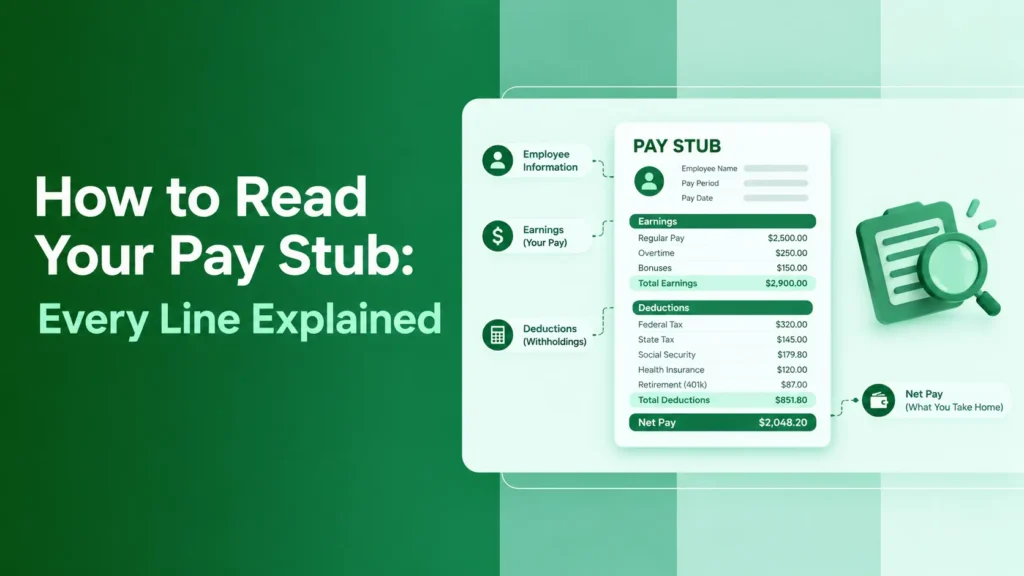
Every US pay stub has five blocks, and they always appear in the same order. Identification, pay period, earnings, deductions, and net pay.
Read them in that order and the whole document makes sense. Read the deductions first, which is what most people do, and it looks like a wall of codes.
This guide explains every line, decodes the abbreviations, and shows you three checks that catch most payroll errors. You can compare any figure against our free paycheck calculator as you read.
The five blocks on every pay stub
- Identification: who you are, who pays you, and which period this covers
- Earnings: your hours, rates, and gross pay before anything comes out
- Pre-tax deductions: benefits taken before tax is calculated
- Taxes withheld: federal, FICA, state and local
- Post-tax deductions and net pay: what actually reaches your bank
Each block has two columns. The current column covers this pay period. The year-to-date column covers everything since 1 January.
Block 1: Identification and pay period
The top of the stub confirms who is being paid and for what dates. It is the block people skip, and it hides two common errors.
- Your name and the last four digits of your Social Security number
- Your employer’s name and address
- Employee or payroll ID
- Pay period start and end dates
- Pay date, which is when the money arrives
- Check or advice number
The pay period and the pay date are different things. A period ending 12 September may not be paid until 19 September.
That lag is normal. It is why your first paycheck at a new job often covers fewer days than you expected.
Block 2: Earnings
This block shows what you earned before anything was taken out.
For hourly workers it lists hours and rates. For salaried workers it usually shows a single amount per period.
| Line | What it means |
| Regular | Standard hours at your base rate |
| Overtime | Hours over 40 in a week, usually paid at 1.5 times your rate |
| Double time | Paid at 2 times your rate, where state law or your contract requires it |
| Holiday or PTO | Paid time off, taken from your accrued balance |
| Bonus or commission | Supplemental pay, often withheld at a flat 22% federal rate |
| Retro | A correction for a prior period, such as a backdated raise |
| Shift differential | Extra pay for nights, weekends or less desirable shifts |
| Gross pay | The total of everything above, before deductions |
Check the hours and rate first. Multiply them yourself. If your gross pay does not match, the error is in this block, not in the tax lines. Our hourly paycheck calculator and overtime calculator will confirm the maths.
Why the year-to-date column matters more
The YTD column is the running total since 1 January. It is what your employer reports to the IRS on your Form W-2.
If a single paycheck is wrong, the YTD column is where it shows up and stays. Check it every quarter rather than every payday.
Block 3: Pre-tax deductions
Pre-tax deductions come out before tax is calculated. They lower the income your tax is based on.
- Traditional 401(k) or 403(b) contributions
- Medical, dental and vision premiums
- Health Savings Account (HSA) contributions
- Flexible Spending Account (FSA) contributions
- Commuter and parking benefits
Why your taxable wages are lower than your gross pay
Many stubs show a separate line called taxable gross or taxable wages. It sits below gross pay and is a smaller number.
That gap is your pre-tax deductions. Some stubs show two different taxable figures, and there is a good reason for it.
A traditional 401(k) contribution lowers your federal taxable wages. It does not lower your Social Security and Medicare wages.
Health premiums, HSA and FSA contributions lower both, because they run through a Section 125 cafeteria plan.
| Deduction | Lowers income tax wages? | Lowers FICA wages? |
| Traditional 401(k) | Yes | No |
| Medical or dental premium | Yes | Yes |
| HSA contribution | Yes | Yes |
| FSA contribution | Yes | Yes |
| Roth 401(k) | No | No |
This is why a stub can show two taxable wage figures that differ by exactly your 401(k) contribution. See the effect on your own pay with the 401(k) paycheck calculator.
Block 4: Taxes withheld
This block is usually the largest on the stub and the one people find hardest to check.
Federal income tax
Shown as FED, FIT or FWT. The amount depends on your salary, your filing status and the Form W-4 you gave your employer.
There is no fixed percentage. Payroll annualises your pay, applies the brackets, then divides back down.
Social Security and Medicare
These two are flat, which makes them the easiest lines to verify yourself.
| Line | Rate | 2026 limit |
| Social Security (OASDI) | 6.2% | First $184,500 of wages |
| Medicare | 1.45% | No limit |
| Additional Medicare | 0.9% | Wages above $200,000 |
The maximum Social Security any employee pays in 2026 is $11,439, per the Social Security Administration. Once your YTD Social Security wages pass $184,500, that line stops and your net pay rises.
State and local income tax
Shown as ST, SIT or SWT for state, and LOC, LIT or the city name for local.
Nine states take nothing from wages. Some cities take their own cut on top of the state rate, including New York City, Yonkers, Philadelphia, Detroit and hundreds of Ohio municipalities. Check yours on the paycheck calculator by state page.
State insurance withholding
Several states deduct employee-paid insurance premiums. These sit near the tax lines but are not income tax.
- CASDI or SDI: California State Disability Insurance, 1.3% in 2026 with no wage cap
- PFL or FLI: paid family leave, for example New York at 0.432% capped at $411.91 a year
- PFML: paid family and medical leave in states such as Washington, Massachusetts and Colorado
Block 5: Post-tax deductions and net pay
Post-tax deductions come out after tax. They lower your take-home pay but save you nothing in tax.
- Roth 401(k) contributions
- Wage garnishments and child support orders
- Union dues
- Life or disability cover that is not pre-tax
- Charitable giving through payroll
Net pay is the final line. It should match the amount deposited in your account to the cent.
Employer contributions and imputed income
Some stubs list amounts your employer pays, marked ER. These do not reduce your net pay.
Imputed income is different. It is the taxable value of a non-cash benefit, and it raises your taxable wages without raising your pay.
Common examples are employer-paid life insurance above $50,000, personal use of a company car, and domestic partner health coverage.
Pay stub abbreviations decoded
Payroll systems abbreviate almost everything. Here is what the common codes mean.
Earnings codes
| Code | Meaning |
| REG, RGLR | Regular pay |
| OT, OVT | Overtime, usually 1.5 times your rate |
| DT | Double time, 2 times your rate |
| HOL | Holiday pay |
| VAC, PTO | Vacation or paid time off |
| SICK | Sick pay |
| BON, BNS | Bonus |
| COMM | Commission |
| RETRO | Retroactive pay for a prior period |
| SD, SHFT | Shift differential |
| GRS | Gross pay |
Tax codes
| Code | Meaning |
| FED, FIT, FWT | Federal income tax withheld |
| FICA | Federal Insurance Contributions Act, covers Social Security and Medicare |
| OASDI, SS, SOC SEC | Social Security, withheld at 6.2% |
| MED, MEDI, FICA-MED | Medicare, withheld at 1.45% |
| ADDL MED | Additional Medicare, 0.9% on wages above the threshold |
| ST, SIT, SWT | State income tax |
| LOC, LIT | Local or city income tax |
| SDI, CASDI | State disability insurance |
| PFL, FLI, PFML | Paid family leave or paid family and medical leave |
| SUI, SUTA | State unemployment insurance, employee share in a few states |
Deduction codes
| Code | Meaning |
| 401K | Traditional 401(k), pre-tax |
| ROTH | Roth 401(k), post-tax |
| HSA | Health Savings Account |
| FSA, DCA | Flexible Spending Account, or dependent care account |
| MED, DEN, VIS | Medical, dental and vision premiums |
| STD, LTD | Short-term and long-term disability cover |
| GTL | Group term life insurance above $50,000, treated as taxable income |
| GARN | Wage garnishment |
| CHSUP | Child support order |
| UNION | Union dues |
Other codes
| Code | Meaning |
| YTD | Year to date, the running total since 1 January |
| EE | Employee, the portion you pay |
| ER | Employer, the portion they pay on top |
| TAXBL GRS | Taxable gross, your pay after pre-tax deductions |
| NET | Net pay, the amount deposited |
| CHK, ADV | Check or direct deposit advice number |
A sample pay stub, line by line
Here is a full stub for a single filer on $75,000, paid every two weeks in California, with no pre-tax deductions.
The year-to-date column shows the position after 18 of the year’s 26 paychecks.
| Line | This period | Year to date |
| Gross pay | $2,884.62 | $51,923.16 |
| Federal income tax | $295.00 | $5,310.00 |
| Social Security (OASDI) | $178.85 | $3,219.30 |
| Medicare | $41.83 | $752.94 |
| California income tax | $107.23 | $1,930.14 |
| CA SDI | $37.50 | $675.00 |
| Net pay | $2,224.21 | $40,035.78 |
These figures come from our own calculation engine, which we test against ADP and SmartAsset across ten cases in five states. Run your own numbers on the California paycheck calculator or build a full stub with the pay stub calculator.
Three checks that catch most payroll errors
You do not need to verify every line. These three catch the majority of real mistakes.
Check 1: gross pay against your salary
Multiply your gross pay by your number of pay periods. It should equal your annual salary.
In the example above, $2,884.62 multiplied by 26 comes to $75,000. If yours does not match, start there.
Check 2: the FICA maths
Social Security should be 6.2% of your taxable wages. Medicare should be 1.45%.
In the example, 6.2% of $2,884.62 is $178.85 and 1.45% is $41.83. Both match the stub.
If these are off, either your taxable wage base is wrong or a deduction is being treated incorrectly.
Check 3: the year-to-date movement
Each YTD figure should have risen by exactly this period’s amount. Compare against your previous stub.
A YTD figure that jumps, stalls or moves backwards is the earliest sign of a correction you were not told about.
What to do if your pay stub is wrong
- Keep the stub, and the one before it, so you can show the change
- Work out the figure you expected and write it down
- Email payroll or HR with the pay date, the line, and both figures
- Ask when the correction will appear and on which paycheck
- If it is not resolved, contact your state labor department, which handles wage complaints
Most errors are genuine mistakes and get fixed on the next run. Putting it in writing gives you a record either way.
How long to keep your pay stubs
Keep each stub for at least a year. You may need one as proof of income for a loan, a lease or a benefits application.
Keep the final stub of the year for at least three years. Check it against your Form W-2 before you file.
If the W-2 and your final stub disagree, ask your employer for a corrected W-2 before filing your return.
Does your employer have to give you a pay stub?
There is no federal requirement. The Fair Labor Standards Act requires employers to keep detailed payroll records for at least three years, but it does not require them to hand you a statement.
Most states do require one, and the rules differ. Some require a printed stub, some allow electronic access, and a few require your consent before going paperless.
Check your own state labor department for the rule that applies to you.
Frequently asked questions
What does YTD mean on a pay stub?
YTD means year to date. It is the running total of everything you have earned and everything withheld since 1 January. The YTD column matters more than the current column, because it is what your employer reports to the IRS on your Form W-2 at the end of the year.
What is OASDI on my paycheck?
OASDI stands for Old-Age, Survivors, and Disability Insurance, which is the formal name for Social Security. It is withheld at 6.2% of your taxable wages. In 2026 it applies only to the first $184,500 you earn, so the maximum any employee pays is $11,439.
Why are my taxable wages lower than my gross pay?
Pre-tax deductions come out before tax is calculated. A traditional 401(k) contribution lowers your federal taxable wages. Health premiums, HSA and FSA contributions lower both your federal taxable wages and your Social Security and Medicare wages, so your stub may show two different taxable figures.
What does EE and ER mean on a pay stub?
EE means employee and ER means employer. An EE line is money taken from your pay. An ER line is money your employer pays on top, such as their share of Social Security or a 401(k) match. ER amounts do not reduce your net pay and are shown for information only.
What should I do if my pay stub is wrong?
Contact your payroll or HR department in writing and include the pay date, the line you are questioning and the figure you expected. Keep the stub. Most errors are corrected on the next paycheck. If it is not resolved, your state labor department handles wage complaints.
How long should I keep my pay stubs?
Keep them until you have checked your Form W-2 against your final stub of the year, then keep that final stub for at least three years. Keep individual stubs for a year if you may need proof of income for a loan, a lease or a benefits application.
Does my employer have to give me a pay stub?
There is no federal requirement. The Fair Labor Standards Act requires employers to keep payroll records but does not require them to hand you a statement. Most states do require one, and the rules vary by state, so check your own state labor department.
What is imputed income on a pay stub?
Imputed income is the value of a non-cash benefit that the IRS treats as taxable. Common examples are employer-paid group term life insurance above $50,000, personal use of a company car, and domestic partner health coverage. It raises your taxable wages without raising your net pay.
The short version
- Read the five blocks in order: identification, earnings, pre-tax deductions, taxes, net pay
- The YTD column is what reaches your W-2, so check it quarterly
- Social Security is 6.2% and Medicare is 1.45%, which makes both easy to verify
- A 401(k) lowers income tax wages but not FICA wages, and that gap is normal
- EE is your money, ER is your employer’s, and imputed income raises tax without raising pay
- Put any query to payroll in writing, and keep the stub
Check any line against the paycheck calculator, or read how your paycheck is calculated for the full method behind every figure.
These figures are estimates for informational purposes and are not tax advice. Actual withholding depends on your employer’s payroll system, your year-to-date wages and your specific W-4. Federal rates come from IRS Rev. Proc. 2025-32 and the SSA 2026 announcement; state rates come from each state’s own withholding guide, with the source and verification date published on every state page. Read the methodology, or see who maintains this data.