
The Complete 2026 W-4 Guide: Every Step Explained
Sep 25, 2026
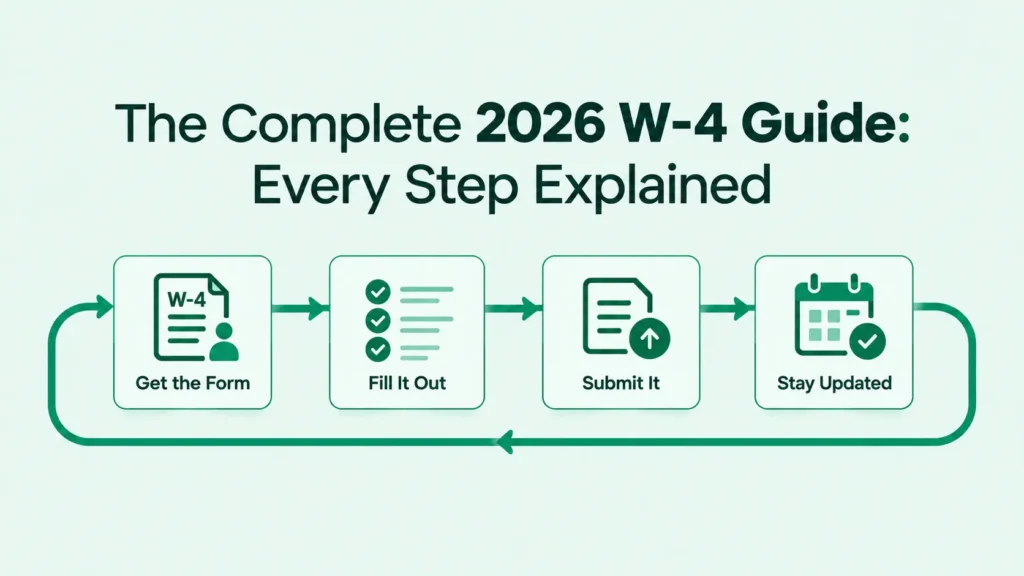
The 2026 W-4 has five steps, and most people only need two of them. Steps 2, 3 and 4 exist for people with more than one job, dependents to claim, or a reason to adjust their withholding.
The form changed this year. The dependent credit went up, three new deductions were added, and claiming exempt now uses a checkbox. This guide covers every line on the 2026 Form W-4, including what is new.
What changed on the 2026 W-4
Start here if you have filled one out before. Four changes matter.
| What changed | 2025 form | 2026 form |
| Step 3 child amount | $2,000 per child under 17 | $2,200 per child under 17 |
| Deductions Worksheet | Shorter, shared page | 15 lines on its own page |
| New deduction lines | None | Qualified tips (1a) and qualified overtime (1b) |
| Claiming exempt | Write the word by hand | Tick a checkbox after Step 4 |
| Form length | 4 pages | 5 pages |
The three new deductions come from the One Big Beautiful Bill Act. They are covered in full under Step 4 below.
The five steps at a glance
| Step | What it covers | Who needs it |
| Step 1 | Name, address, Social Security number, filing status | Everyone |
| Step 2 | Multiple jobs or a working spouse | Anyone with more than one income |
| Step 3 | Dependents and other credits | Anyone claiming dependents |
| Step 4 | Other income, deductions, extra withholding | Optional adjustments |
| Step 5 | Signature and date | Everyone |
Give the finished form to your employer. Never send it to the IRS.
Step 1: Personal information and filing status
Three lines, and the third one does real work.
- 1(a): your name and address
- 1(b): your Social Security number
- 1(c): your filing status
Choosing the right filing status
Your filing status sets which standard deduction and which bracket table payroll uses. Getting it wrong is the most common W-4 error.
| Option on the form | 2026 standard deduction used |
| Single or married filing separately | $16,100 |
| Married filing jointly or qualifying surviving spouse | $32,200 |
| Head of household | $24,150 |
Head of household is not the same as being the main earner. You generally need to be unmarried and paying more than half the cost of a home for a qualifying person.
If you are unsure, single is the safer choice. It withholds more, which means a refund rather than a bill.
Step 2: Multiple jobs or spouse works
Skip this if you have one job and no working spouse. If you do not skip it when you should have, you will owe money in April.
The reason is simple. Each employer assumes its job is your only income, so each one gives you the full standard deduction.
The three ways to complete Step 2
- 2(a): use the IRS Tax Withholding Estimator online. The most accurate option, and the one to use if your incomes are very different
- 2(b): use the Multiple Jobs Worksheet on page 3 of the form
- 2(c): tick the checkbox. Only valid when there are exactly two jobs in total
The IRS Tax Withholding Estimator is free and takes about ten minutes. Have your most recent pay stub and your spouse’s to hand.
What the 2(c) checkbox actually does
Ticking box 2c tells payroll to halve your standard deduction and halve every bracket threshold.
The effect is more federal tax withheld from each paycheck. That is the point, because two jobs together push you into a higher bracket.
Two rules for 2c. Both jobs must tick it, and it only works when the two jobs pay roughly the same.
If one job pays far more than the other, use the estimator instead. The checkbox will over-withhold badly on very uneven incomes.
You can see the size of the difference on our paycheck calculator, which has a two-jobs option under Advanced.
Step 3: Claim dependents and other credits
This is where the 2026 form changed most visibly.
- 3(a): multiply qualifying children under age 17 by $2,200
- 3(b): multiply other dependents by $500
- Add both and enter the total on the Step 3 line
The child figure rose from $2,000 to $2,200 for 2026. Two children under 17 now reduce your annual federal withholding by $4,400.
Other dependents include children aged 17 and over, and adult relatives you support. They stay at $500 each.
The mistake that causes an April bill
Only one job should claim dependents. If you and your spouse both claim the same children, your household is under-withheld by the full amount twice.
The IRS instruction is to claim them on the higher-paying job only. Leave Step 3 blank on the other one.
Step 4: Other adjustments
Step 4 is where you fine-tune. It is no longer labelled optional on the 2026 form, but you can still leave it blank.
4(a): Other income not from jobs
Enter annual income that has no withholding of its own. Interest, dividends, retirement income and most freelance income belong here.
Payroll spreads the extra tax across your paychecks. It is a cleaner method than making quarterly estimated payments.
4(b): Deductions, and the new worksheet
Use this only if you expect to claim more than the standard deduction. The Deductions Worksheet now runs to 15 lines on its own page.
If you leave 4(b) blank, payroll assumes you take the standard deduction. For most people that is correct.
The three new deductions for 2026
The Deductions Worksheet added lines for deductions created by the One Big Beautiful Bill Act. These are new this year.
| Deduction | Maximum | Income limit |
| Qualified tips (line 1a) | $25,000, or $50,000 married filing jointly | Under $150,000, or $300,000 married filing jointly |
| Qualified overtime (line 1b) | $12,500, or $25,000 married filing jointly | Under $150,000, or $300,000 married filing jointly |
| Qualified vehicle loan interest | $10,000 | Under $100,000, or $200,000 married filing jointly |
The overtime deduction covers only the premium half of time-and-a-half pay, not the whole overtime payment.
There is also a $6,000 deduction for taxpayers aged 65 and over, which appears on the same worksheet.
If you earn tips or regular overtime, this is the most valuable change on the form. Work out the effect on your pay with the overtime calculator.
4(c): Extra withholding
A flat dollar amount taken from every paycheck, on top of everything else. It is the simplest lever on the whole form.
Use it when you know you will owe, or when you want a larger refund. It is also the easiest way to correct a shortfall late in the year.
The amount is per paycheck, not per year. Entering $100 with biweekly pay withholds $2,600 more across the year.
Step 5: Sign and date
A W-4 without a signature is not valid. Your employer cannot act on it.
Your employer completes the box beside it with their name, address, employer identification number and your start date.
How to claim exempt in 2026
The 2026 form has a dedicated checkbox after Step 4. You no longer write the word by hand.
You can only claim exempt if both of these are true.
- You had no federal income tax liability last year
- You expect no federal income tax liability this year
Exempt status expires. You must file a new W-4 each year, usually by mid-February, or your employer will withhold at the single rate.
Claiming exempt when you do not qualify leaves you with a tax bill and possible penalties. Social Security and Medicare are still withheld either way.
Six common W-4 mistakes
- Skipping Step 2 when you have two jobs or a working spouse
- Both spouses claiming the same dependents in Step 3
- Claiming dependents on the lower-paying job instead of the higher one
- Treating 4(c) as an annual figure when it is per paycheck
- Filling in 4(b) when you actually take the standard deduction
- Never updating the form after a raise, a marriage or a new child
When to update your W-4
There is no annual requirement. Update it when something changes.
- You marry, divorce or your spouse starts or stops working
- You have a child or a dependent leaves home
- You take a second job or lose one
- You get a significant raise or bonus
- You buy a home and start itemising
- You owed a large amount or received an unusually large refund last year
A new W-4 takes effect on the next payroll run after your employer processes it. Changes are not backdated.
How to check your W-4 is working
Do this once, a few weeks after you file a new form. It takes five minutes.
- Take your latest pay stub and find the federal income tax line
- Enter the same salary, filing status and pay frequency into a paycheck calculator
- Compare the two federal withholding figures
- If they differ by more than a few dollars, something on your W-4 is not what you think it is
Our take-home pay calculator has every W-4 field under Advanced, so you can test a change before you file it. Our guide to reading your pay stub explains which line to compare.
Do this in the first half of the year if you can. Correcting a shortfall across ten remaining paychecks is easier than across two.
Frequently asked questions
What changed on the 2026 Form W-4?
Four things. The dependent credit in Step 3 rose from $2,000 to $2,200 per qualifying child under 17. The Deductions Worksheet expanded to 15 lines on its own page. New lines were added for qualified tips and qualified overtime. A checkbox now replaces writing the word exempt by hand.
How do I fill out a W-4 in 2026?
Complete Step 1 with your name, Social Security number and filing status, then sign Step 5. Steps 2, 3 and 4 are only needed if you have more than one job, claim dependents, or want to adjust your withholding. Most single-job filers only complete Steps 1 and 5.
How much is the dependent credit on the 2026 W-4?
Step 3 uses $2,200 for each qualifying child under age 17 and $500 for each other dependent. The child amount increased from $2,000 for 2026. Multiply, add the two figures together, and enter the total on the Step 3 line.
What does the two jobs checkbox in Step 2c do?
Ticking box 2c tells payroll to halve your standard deduction and halve every tax bracket threshold. That raises your withholding, because each job would otherwise assume it is your only income. Both jobs must tick it, and only if there are exactly two jobs in total.
What is the qualified tips deduction on the 2026 W-4?
It is a new deduction of up to $25,000 in qualified tip income, or $50,000 for married filing jointly. It is available to employees with income below $150,000, or $300,000 if married filing jointly. You estimate it on line 1a of the Deductions Worksheet.
How often should I update my W-4?
Update it whenever your situation changes. Common triggers are marriage, divorce, a new baby, a second job, a spouse starting or leaving work, a large raise, and buying a home. Also update it if you owed a lot or received a very large refund last year.
Can I claim exempt from withholding on my W-4?
Only if you had no federal income tax liability last year and expect none this year. The 2026 form has a checkbox for this after Step 4. Exempt status expires each year, so you must file a new W-4 by mid-February to keep it in place.
Why do I still owe tax when my employer withholds?
Usually because your W-4 does not reflect your full picture. A second job, freelance income, a working spouse or investment income can all leave you under-withheld. Each employer assumes it is your only source of income unless Step 2 tells it otherwise.
The short version
- Most people only need Step 1 and Step 5
- Step 2 is the one that causes April bills when skipped
- Step 3 now uses $2,200 per child under 17, up from $2,000
- Step 4 gained deductions for qualified tips, qualified overtime and vehicle loan interest
- Claiming exempt is now a checkbox, and it expires every year
- Check the result on your next pay stub rather than assuming it worked
Test any W-4 change before you file it on our paycheck calculator, or read how your paycheck is calculated for the full method behind the numbers.
These figures are estimates for informational purposes and are not tax advice. Actual withholding depends on your employer’s payroll system, your year-to-date wages and your specific W-4. Federal rates come from IRS Rev. Proc. 2025-32 and the SSA 2026 announcement; state rates come from each state’s own withholding guide, with the source and verification date published on every state page. Read the methodology, or see who maintains this data.