
How to Calculate Hours Worked and What They Actually Pay
October 12, 2026
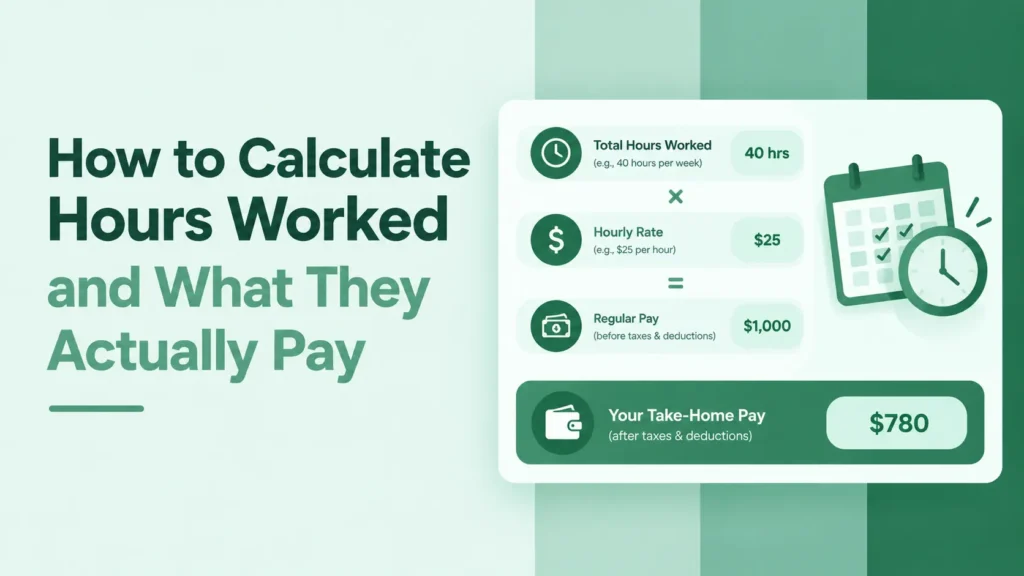
Here is how to calculate hours worked in one line. Subtract clock-in from clock-out, remove unpaid meal breaks, and divide leftover minutes by 60.
Add every shift in the workweek together. Under federal law, any hours above 40 are overtime and pay 1.5 times your regular rate.
That covers the arithmetic. This guide also explains which minutes count, how rounding works, and what your hours pay after 2026 taxes.
Short on time? Enter your shifts in the timesheet calculator and it does every step below for you.
The formula at a glance
- Hours per shift = clock-out time minus clock-in time, minus unpaid meal breaks
- Decimal hours = whole hours plus (minutes ÷ 60)
- Weekly hours = the sum of every shift in one fixed 7-day workweek
- Gross pay = (regular hours × rate) + (overtime hours × rate × 1.5)
Each of those four lines has a rule behind it. The sections below take them one at a time.
How to calculate hours worked in 5 steps
This is the same method payroll teams use. It works for a paper timesheet, a phone app or a time clock export.
Step 1: Record your start and end times
Write down the exact time you clocked in and out for every shift. Use the minute, not the nearest half hour.
Then convert to 24-hour time. 4:30 PM becomes 16:30, which stops afternoon times from subtracting wrongly.
Step 2: Subtract the start time from the end time
A shift from 8:00 to 16:30 is 8 hours and 30 minutes on the clock. If the minutes come out negative, borrow 60 minutes from the hours.
For overnight shifts, add 24 hours to the end time first. A shift from 22:00 to 06:00 is 30:00 minus 22:00, or 8 hours.
Step 3: Remove unpaid meal breaks only
Subtract a meal break only if it lasted 30 minutes or more and you were fully off duty. Short rest breaks of 5 to 20 minutes stay in your hours.
This one step causes more pay disputes than any other. The full rules are in the next section.
Step 4: Convert minutes to decimal hours
Payroll systems multiply your rate by decimal hours, not by hours and minutes. Divide the minutes by 60 to convert.
So 8 hours and 45 minutes becomes 8 + (45 ÷ 60), or 8.75 hours. Never write it as 8.45, which underpays you by 18 minutes.
Step 5: Total the workweek and separate overtime
Add the decimal hours for every shift in the same workweek. Anything above 40.00 goes in a separate overtime column.
Here is a sample week worked through all five steps, at $20 an hour:
| Day | In | Out | Unpaid meal | Hours worked |
| Monday | 08:00 | 16:30 | 30 min | 8.00 |
| Tuesday | 07:45 | 16:15 | 30 min | 8.00 |
| Wednesday | 08:10 | 17:40 | 30 min | 9.00 |
| Thursday | 08:00 | 16:00 | 30 min | 7.50 |
| Friday | 08:05 | 17:20 | 45 min | 8.50 |
| Week total | 41.00 |
That week has 40 regular hours and 1 overtime hour. Gross pay is (40 × $20) + (1 × $30), which equals $830.
Minutes to decimal hours chart
Keep this chart next to your timesheet. Each value is the minutes divided by 60, rounded to two places.
| Minutes | Decimal | Minutes | Decimal | Minutes | Decimal |
| 5 | 0.08 | 25 | 0.42 | 45 | 0.75 |
| 10 | 0.17 | 30 | 0.50 | 50 | 0.83 |
| 15 | 0.25 | 35 | 0.58 | 55 | 0.92 |
| 20 | 0.33 | 40 | 0.67 | 60 | 1.00 |
Need the odd minutes, such as 7 or 53? The work hours calculator converts any time span to exact decimals.
What counts as hours worked under federal law
The rules come from the Fair Labor Standards Act and its regulations in 29 CFR Part 785. The Department of Labor summarizes them in Fact Sheet #22.
Time that counts and must be paid
- Rest breaks of about 5 to 20 minutes. Federal rules say they must be counted as hours worked.
- Meal breaks where you still have duties, such as watching a register or answering calls.
- Work you were not asked to do but your employer knew about, including finishing tasks after your shift.
- On-call time you must spend on the employer’s premises.
- Required training, meetings and job-related courses held by your employer.
- Travel between job sites during the workday, and one-day trips to another city.
Time that usually does not count
- Bona fide meal periods, usually 30 minutes or more, when you are completely relieved from duty.
- Normal commuting from home to your regular workplace.
- On-call time at home, when you are free to use the time mostly for yourself.
- Voluntary training outside work hours that is not related to your current job.
One point surprises many workers. An employer cannot avoid paying for work simply by having a rule against it. If the employer knows the work happens, it must pay for it.
Timesheet rounding rules
Federal rules allow employers to round punches to the nearest 5 minutes, tenth of an hour or quarter hour. That permission sits in 29 CFR 785.48.
Quarter-hour rounding is the most common, and it is often called the 7-minute rule. Punches 1 to 7 minutes past a quarter round down. Punches 8 to 14 minutes past round up.
| Actual punch | Rounded to | Why |
| 08:07 | 08:00 | 7 minutes past the quarter, rounds down |
| 08:08 | 08:15 | 8 minutes past the quarter, rounds up |
| 16:52 | 16:45 | 7 minutes past the quarter, rounds down |
| 16:53 | 17:00 | 8 minutes past the quarter, rounds up |
The key condition is fairness over time. Rounding is legal only if it does not, over time, fail to pay employees properly.
A policy that always rounds clock-ins later and clock-outs earlier fails that test. If your rounded hours run below your real hours week after week, keep your own record.
How overtime is calculated
Under the FLSA, non-exempt workers earn at least 1.5 times their regular rate after 40 hours a week. The Department of Labor explains this in Fact Sheet #23.
Three details decide whether your overtime is right:
- A workweek is a fixed, recurring 168-hour period. It can start on any day, but it cannot move week to week.
- Averaging is not allowed. Each workweek stands alone, even when you are paid every two weeks.
- Federal law has no daily overtime rule, and no automatic premium for weekends or holidays.
The biweekly trap
Say you work 35 hours one week and 45 the next, at $20 an hour. That is 80 hours, exactly two times 40.
It is still 5 hours of overtime, because week two stands alone. Correct pay is $1,650. Paying all 80 hours at $20 gives only $1,600.
Check a two-week check against the rule with the biweekly paycheck calculator.
States that add daily overtime
California is the main exception. According to the state’s Division of Labor Standards Enforcement, it requires:
- 1.5 times pay for hours over 8 in a workday, up to 12
- Double pay for hours over 12 in a workday
- 1.5 times pay for the first 8 hours on a seventh straight workday, then double time
- 1.5 times pay for hours over 40 in the workweek
Take four 10-hour days at $20. Federal law sees 40 hours and no overtime, so pay is $800.
California sees 8 daily overtime hours. Pay is (32 × $20) + (8 × $30), which equals $880.
Colorado also has a daily trigger, after 12 hours, per the Department of Labor state table. Check your own state page, such as California or Colorado.
What your hours pay before taxes
Gross pay is simple once hours are right. Multiply regular hours by your rate, then add overtime hours at 1.5 times that rate.
Check your rate against the minimum wage first. The federal floor is $7.25 an hour, but many states set it higher.
| Location | Minimum wage per hour (2026) |
| Federal (FLSA) | $7.25 |
| California | $16.90 |
| Washington | $17.13 |
| New York City, Long Island, Westchester | $17.00 |
| New York, rest of state | $16.00 |
| Illinois | $15.00 |
Source: U.S. Department of Labor, State Minimum Wage Laws, updated July 1, 2026. Some cities set higher rates again.
What your hours actually pay after taxes
This is the number that reaches your bank account. Each figure below is one 40-hour week, paid weekly, for a single filer.
| Hourly rate | Gross per week | Texas take-home | California take-home | Texas net per hour |
| $15 | $600.00 | $524.02 | Below CA minimum | $13.10 |
| $18 | $720.00 | $620.44 | $601.72 | $15.51 |
| $20 | $800.00 | $684.72 | $661.76 | $17.12 |
| $25 | $1,000.00 | $845.42 | $809.93 | $21.14 |
| $30 | $1,200.00 | $1,006.12 | $956.03 | $25.15 |
| $35 | $1,400.00 | $1,154.71 | $1,086.28 | $28.87 |
| $40 | $1,600.00 | $1,295.41 | $1,207.15 | $32.39 |
| $50 | $2,000.00 | $1,576.81 | $1,446.15 | $39.42 |
Figures cover federal income tax, Social Security, Medicare, state income tax and California SDI. They assume the standard deduction, no dependents and no benefit deductions.
Texas has no state income tax, which is why its column runs higher. At $25 an hour, a Texas worker keeps about $21.14 of every hour worked.
For a full breakdown at each rate, see the dedicated pages:
$15 · $18 · $20 · $25 · $30 · $35 · $40 · $50
To turn an hourly rate into a yearly figure, the hourly to salary calculator uses the standard 2,080 hours.
How much of your overtime you keep
Overtime is not taxed at a special rate. It is ordinary wages, added to the same paycheck and taxed through the same brackets.
Here is a $20-an-hour worker in Texas, paid weekly, single filer:
| Hours that week | Gross pay | Take-home | Extra kept vs 40 hours |
| 40 | $800.00 | $684.72 | n/a |
| 45 (5 overtime) | $950.00 | $805.24 | $120.52 of $150.00 |
| 50 (10 overtime) | $1,100.00 | $925.77 | $241.05 of $300.00 |
Ten overtime hours add $300 gross and $241.05 net. That is about 80 cents kept from each overtime dollar.
Why does a big overtime check sometimes feel overtaxed? Payroll treats that one check as if every week looked the same. Any extra withholding comes back when you file your return.
Model your own week with the overtime calculator, or a full check with the hourly paycheck calculator.
The 2026 overtime tax deduction, in plain terms
The One Big Beautiful Bill Act created a federal deduction for qualified overtime pay. The IRS updated its guidance in Fact Sheet FS-2026-13.
Here is what the IRS guidance says:
- Only the premium is deductible. That is the extra half in time and a half, not the whole overtime payment.
- Only overtime the FLSA requires qualifies. State daily overtime and employer extras above that minimum do not.
- The cap is $12,500 a year, or $25,000 on a joint return.
- It shrinks once modified adjusted gross income passes $150,000, or $300,000 for joint filers.
- It cuts federal income tax only. Social Security and Medicare still apply to the full overtime pay.
- From 2026, employers report qualified overtime on Form W-2, Box 12, using code TT.
The IRS gives a worked formula. Qualified overtime equals hours over 40, times one-half, times the regular rate.
So 10 overtime hours at a $20 regular rate gives 10 × 0.5 × $20. That is $100 of qualified overtime.
Will it change your paycheck?
Not automatically. The IRS says employers cannot reduce withholding for this deduction unless you give them an updated Form W-4.
You enter the expected deduction in Step 4(b). For example, 5 overtime hours every week at $20 is $2,600 of qualified overtime a year.
For a Texas single filer, entering $2,600 adds about $6 to each weekly check. That is $312 over the year.
Our 2026 W-4 guide explains Step 4(b) line by line. The 2026 tax changes summary covers the other new deductions.
Common mistakes when calculating hours
- Writing 7 hours 30 minutes as 7.30 instead of 7.50
- Deducting paid rest breaks along with unpaid meal breaks
- Averaging overtime across a two-week pay period
- Forgetting overnight shifts that cross midnight
- Leaving out pre-shift tasks, such as setting up equipment or logging in
- Assuming every state follows the federal weekly-only overtime rule
Hours right but the check wrong? Compare it line by line using how to read your pay stub.
Keep your own record
Employers must keep accurate time records under the FLSA. Your own log is still the fastest way to catch an error.
- Note clock-in, clock-out and meal times the same day
- Keep pay stubs for at least the current year
- Compare each check’s hours with your log before you spend it
If you find a gap, raise it with payroll first. Unresolved wage issues can go to the Department of Labor Wage and Hour Division or your state labor office.
Frequently asked questions
How do I calculate my hours worked?
Subtract clock-in from clock-out for each shift, then subtract unpaid meal breaks. Convert minutes by dividing by 60 and add the week together.
How do I convert minutes to decimal hours for payroll?
Divide the minutes by 60. Fifteen minutes is 0.25, 30 minutes is 0.50 and 45 minutes is 0.75.
Are lunch breaks counted as hours worked?
Not when they last 30 minutes or more and you are fully off duty. If you must work while eating, the time counts and must be paid.
Can my employer round my time clock punches?
Yes, to the nearest 5 minutes, tenth of an hour or quarter hour. The rounding must even out over time and not shortchange you.
Is overtime calculated per day or per week?
Federally, per week, for hours over 40. California also pays daily overtime after 8 hours and double time after 12.
Is overtime taxed at a higher rate?
No. It is taxed as normal wages. A large overtime check may show higher withholding, which is settled when you file.
How does the no tax on overtime deduction work in 2026?
You can deduct the premium half of FLSA overtime, up to $12,500 or $25,000 jointly. It lowers income tax only, not FICA.
How many work hours are in a year?
A 40-hour week for 52 weeks equals 2,080 hours. Payroll uses that figure when converting between hourly and salary pay.
These figures are estimates for informational purposes and are not tax advice. Actual withholding depends on your employer’s payroll system, your year-to-date wages and your specific W-4. Federal rates come from IRS Rev. Proc. 2025-32 and the SSA 2026 announcement; state rates come from each state’s own withholding guide, with the source and verification date published on every state page. Read the methodology, or see who maintains this data.